 English
 Indian
 العربية
 Español
 Deutsch
 Türkçe
 Русский
 Français (Afrique)

Ex-MS engineer reveals the story behind the infamous 'FCKGW' Windows XP key: 'Pirates started baking the key into images or just writing it on the CD with a Sharpie'
Ex-Microsoft engineer David Plummer has revealed that he was the "primary author" of Windows XP's Product Activation system on the OS side, and so he's got some inside details on the workings behind the infamous "FCKGW" product key. You know, the one that seemed to be written on every pirated, home-burnt CD copy of the OS back in the day.
No clue? Me neither. I'm completely unaware of such illicit activity, and I reject any accusation otherwise. Anyway, the famous (and now defunct) key was, in its entirety, FCKGW-RHQQ2-YXRKT-8TG6W-2B7Q8—and Plummer thinks it may well have been leaked by an OEM or similar with early access to Microsoft's then-new, all-blue XP operating system. liveiplscore.homes
"As you likely recall, Product Activation required that you have a key, and you’d have to activate it online or over the phone," Plummer begins. "But Microsoft had large corporate customers... and those customers did not want to have to activate every offline PC."
Said customers would be given a Volume Media disc image, which could then be unlocked with a Volume Key. To confirm the legitimacy of such an install, the product activation system would inspect the disc image to find a secret 10 MB "binary blob" which was only present on the Volume Media. As a fun aside, this data blob just happened to be an encrypted version of Microsoft Bob.
"I took their disc data and compressed and encrypted it several times," says Plummer. "Rest assured it’s encrypted and even in the AI age no one has extracted it yet. I really just needed random data, so I started with a precompressed binary image because, secretly, I was young and didn’t know if I could trust CryptGenRand."
This is the story of FCKGW-RHQQ2-YXRKT-8TG6W-2B7Q8.I was the primary author of Windows Product Activation on the operating systems side. Not the key math – those were the ACTUALLY smart guys with heads so big that they bumped the doorjamb on the way into your office. I just did… pic.twitter.com/GyndVkzlHhSeptember 15, 2026
"And so, if you ever tried the FCKGW key on a regular XP CD, it wouldn’t work," Plummer continues, "because you didn't have Bob in your bits. But if you had the means in 1995 to download large ISO binaries or copy CDs, all it took was the key and a copy of the disc."
Unfortunately for Microsoft, a piracy group called Devils0wn posted a complete Windows XP Pro Corporate ISO five weeks before the official launch, alongside the valid FCKGW key. As Windows Product Activation skipped the rest of the validation process once a mathematically valid key was combined with the Volume Media data check, ta-da, a seemingly-legitimate install of Windows XP was yours.
"Pirates then started baking the key into images or just writing it on the CD with a Sharpie," says Plummer. As for where the key itself came from, he speculates that "the most plausible source is an OEM or hardware partner that received final media early so they could ship PCs on launch day.
"Dell is the name that comes up most often; Intel has also been mentioned because of later source dumps. There were very few organizations that actually possessed a VLK [Volume License Key] that early, which is why the timing points at a partner rather than a random corporate customer."

"But I do not know," Plummer confirms. "Presumably someone does."
In the aftermath, Microsoft started blacklisting product IDs belonging to the leaked keys in Service Pack 1, while Service Pack 2 "made the check more aggressive" and started blocking updates for installs using the key. However, Plummer says that valid, un-leaked VLKs continued to work with Volume Media versions of XP for years.
"The operational failure was that the media and one of those keys left the building before the product even reached stores," Plummer concludes. "Once both pieces were public, WPA’s hardware-binding never got a chance to run."
Interestingly, Plummer says in the comments that he never came across a keygen that actually worked for Windows XP, while others in the thread have speculated that those available at the time were simply faking the generation part and randomly selecting leaked Volume Media keys from a list.
Ah, the internet really was the wild west back in those days, that's for sure. Still, now you know why that mysterious sequence of numbers and letters worked for so long, and later became ingrained in the memory of many PC users. Not me, though. First time I've ever seen it in my life, guv. Honest.
Test: Isle of Reveries – Nostalgische Hommage an die GameBoy-Zeldas
Es wird derzeit das 40-jährige Jubiläum der Legend of Zelda-Reihe zelebriert und daher blicken alle aktuell erwartungsvoll auf das Remake von Ocarina of Time. Wir schweifen heute mit unserem Blick jedoch ein wenig ab und schauen uns Isle of Reveries an, ein kleines Indie-Zeldalike, welches sich vor allem an den Spielen für den GameBoy orientiert. Wer also riesiger Fan von Link’s Awakening ist, der sollte jetzt vielleicht etwas aufpassen.
Besucht die Insel der Tagträume… und kehrt nie wieder zurück!
Wir erleben die Abenteuer der kleinen Eule Lief, die auf die Isle of Reveries, also „Insel der Tagträume“ reist. Dort pilgern zahllose Tiere hin, denn dort soll man sich seine sehnlichsten Wünsche erfüllen können und Lief möchte gerne ihre verstorbene Mutter wiederbeleben. Doch Gerüchte besagen auch, dass niemand je von der Insel zurückgekehrt ist.
Sind wir mal ehrlich, die Narrative von Isle of Reveries ist nett, aber mehr auch nicht. Wir treffen einige quirlige NPCs, die alle interessante Dinge erzählen, meist aber nur auf ihre jeweilige Nebenquest bezogen. Im Laufe der Geschichte sind wir doch nur ein weiterer Laufbursche der Götter oder irgendeiner Fee, die uns zum Retter der Insel erkoren hat. Und so klappern wir die Insel ab, erkunden gefährliche Dungeons und besiegen Monster, manche groß, andere etwas kleiner. Die Geschichte bietet einige kleinere Twists hier und da, aber auch hier wird sich am Vorbild orientiert. Die Zelda-Spiele waren immerhin noch nie wirklich bekannt für ihre bahnbrechenden Erzählungen.

Hmm, ein sprechender Baum… Wo habe ich das nur schon mal gesehen? | Bild: 2026 © desertcucco
Vertrautes Gefühl für erfahrene Abenteurer*innen
Vielmehr steht das Gameplay im Vordergrund und das ist in Isle of Reveries sehr gut. Der Gameplayloop ist bekannt: Wir erkunden eine Oberwelt, besiegen Monster mit unserem Schwert oder anderen Mitteln und erkunden Höhlen und vor allem große Dungeons. In diesen lösen wir Rätsel, finden Schlüssel für verschlossene Türen und einen Bossschlüssel für die Bosstür. Hinter dieser wartet ein Boss, bei dem wir das Item, welches wir in diesem Dungeon gefunden haben, verwenden müssen, um ihn zu besiegen. Das alles ist nicht neu, aber Isle of Reveries setzt es mühelos um. Die Rätsel sind bereits im ersten Dungeon schön knackig und vor allem die Ideen bei den Bossen wissen zu gefallen. Außerdem hat Isle of Reveries einen netten Gameplaykniff, der oft in Rätseln zur Verwendung kommt. Wir werden nämlich von einer kleinen Fee begleitet, die jederzeit Objekte kopieren kann. Diese Kopie können wir dann jederzeit verwenden. Also können wir einen Block kopieren und ihn auf einem Schalter platzieren. Oder wir kopieren einen Feuerspeier, um weit entfernte Fackeln zu entzünden. Es entsteht dadurch eine recht clevere Dynamik, dass man dieses Feature bei Rätseln immer im Hinterkopf behalten muss.
Außerhalb der Dungeons gibt es natürlich viel zu sammeln. Da wären die bekannten Herzteile, die es natürlich in einem guten Zeldalike geben muss, vier von ihnen erhöhen eure Lebensenergie. Dann gibt es aber noch etliche andere Sammelobjekte. Magische Samen können gepflanzt werden, um magische Trinkets mit Spezialeffekten zu ernten und ein Waschbär schickt uns auf die Jagd nach verschollenen Blättern. Monster lassen allerlei Materialen fallen und unter Gras und Stein finden wir so manches Krabbeltier, für welches sich Käfersammler sicher interessieren. Außerdem können wir jedes Monster fotografieren und unserem Glossar hinzufügen und auch jeder NPC, den wir treffen, wird bildlich festgehalten. Isle of Reveries lässt sich in gut 15 Stunden durchspielen, doch wenn man wirklich alles erledigen möchte, kann man hier noch deutlich mehr Zeit verbringen.

In den Dungeons, aber auch außerhalb, erwarten euch knackige Rätsel. | Bild: 2026 © desertcucco
Upps, da hab ich mich wohl etwas versprungen
Wenn ihr einen schlechten Orientierungssinn habt, dann könnt ihr sogar noch etwas länger auf der Insel verbringen, denn man kann sich schon mal gut verlaufen. Ja, es gibt eine Karte und diese ist genauso aufgebaut wie damals in den GameBoy-Zeldas, aber irgendwie bekommt man manchmal trotzdem nicht das Gefühl einer zusammenhängenden Welt. Vor allem bei so vielen Sammelobjekten wäre es heutzutage sehr nett, wenn man Möglichkeiten zur Markierung der Karte hätte.
So läuft man manchmal etwas blind umher und untersucht die Ortschaften. Dabei macht das etwas minderwertige Platforming die Reise etwas schwerer. Lief kann nämlich springen und so Abgründe und Gewässer überqueren. Das ging zwar in den GameBoy-Zeldas mit der Greifenfeder auch, aber dort war die Steuerung deutlich präziser. Selbst wenn Link beinahe einen Abgrund hinunterfiel, konnte man sich noch irgendwie retten. Dieses Zeitfenster ist in Isle of Reveries leider sehr ungnädig und so landet man sehr oft in den Tiefen eines Lochs oder im kühlen Nass. Generell fühlt sich die Steuerung stellenweise etwas schwammig an und erfordert etwas an Eingewöhnungszeit.

Bosse sind ein Highlight des Spiels. | Bild: 2026 © desertcucco
Pixelart und Chiptunes, gibt es was Schöneres?
Das alles gerät aber direkt in Vergessenheit, sofern ihr große Game-Boy-Nostalgiker seid, denn die Optik und die Chiptune-Musik katapultieren uns direkt zurück in die Ära von Nintendos erstem Handheld. Die wunderschön in Pixelart gestaltete Spielwelt strahlt dabei eine ganz eigene Mystik aus und wenn jeder Dungeon eine eigenen Signaturmelodie bekommt, fühle ich mich direkt zurückversetzt. In diesem Aspekt hat desertcucco, das Indiestudio hinter Isle of Reveries, ganze Arbeit geleistet.


Titelbild: 2026 © desertcucco
Fazit zu Isle of Reveries
Isle of Reveries ist eine wunderbare Hommage and Link’s Awakening und die Oracle-Spiele. Es hat zwar seine Ecken und Kanten, besonders im Platforming und bei der Orientierung, überzeugt aber in jeglichen anderen Aspekten des Spiels. Die Rätsel sind clever und zahlreich, die NPCs sind alle interessante Figuren und die Präsentation sowohl in Optik als auch im Sound sind eine Augen- und Ohrenweide für Liebhaber*innen der GameBoy-Ära. Ich kann dieses Spiel also jedem GameBoy-Zelda-Fan wärmstens empfehlen.
Maarten Cherek (Redakteur)
Der Beitrag Test: Isle of Reveries – Nostalgische Hommage an die GameBoy-Zeldas erschien zuerst auf NAT-Games.
Balatro developer LocalThunk turns up on Discord to talk about the 1.1 update and life after burnout: 'I truly am having the best time making the game now'
It's been a good while since we last heard about Balatro's big 1.1 update—a year, almost to the day, since developer LocalThunk delayed it into 2026. There's still no sign of it, but the community did catch sight of LocalThunk yesterday when he popped into the Balatro Discord to let everyone know that everything is going fine.
"I'm happy the leaks are going over so well," LocalThunk wrote, referring to teases about the 1.1 update that he's been posting himself. For instance:

"I know you guys want to know as much as possible about 1.1 but I can't give away too much. I know it's taken a very long time and I've completely blown past the 2025 time frame but I promise I'm cooking in the way that is both best for me and ultimately for the game."
That tracks back to LocalThunk's 2025 message about the 1.1 delay, in which he said he became "well and truly burned out" after going too hard for too long on Balatro's development. After taking an extended break, he "very slowly" eased back into the work and was approaching more like a hobby developer, avoiding deadlines and not "trying to force things creatively." He also expressed regret for announcing the then-2025 release target for the 1.1 update, a point he reiterated in his new message.
"I understand how frustrating that must be and I wish I could go back in time and slap some sense into myself," Localtnunk continued. "At the time it was still go-go-go and I never even considered that I could allow myself to stop, then after mobile came out I was just so burnt out I couldn't touch the game for a bit. Luckily things have changed."
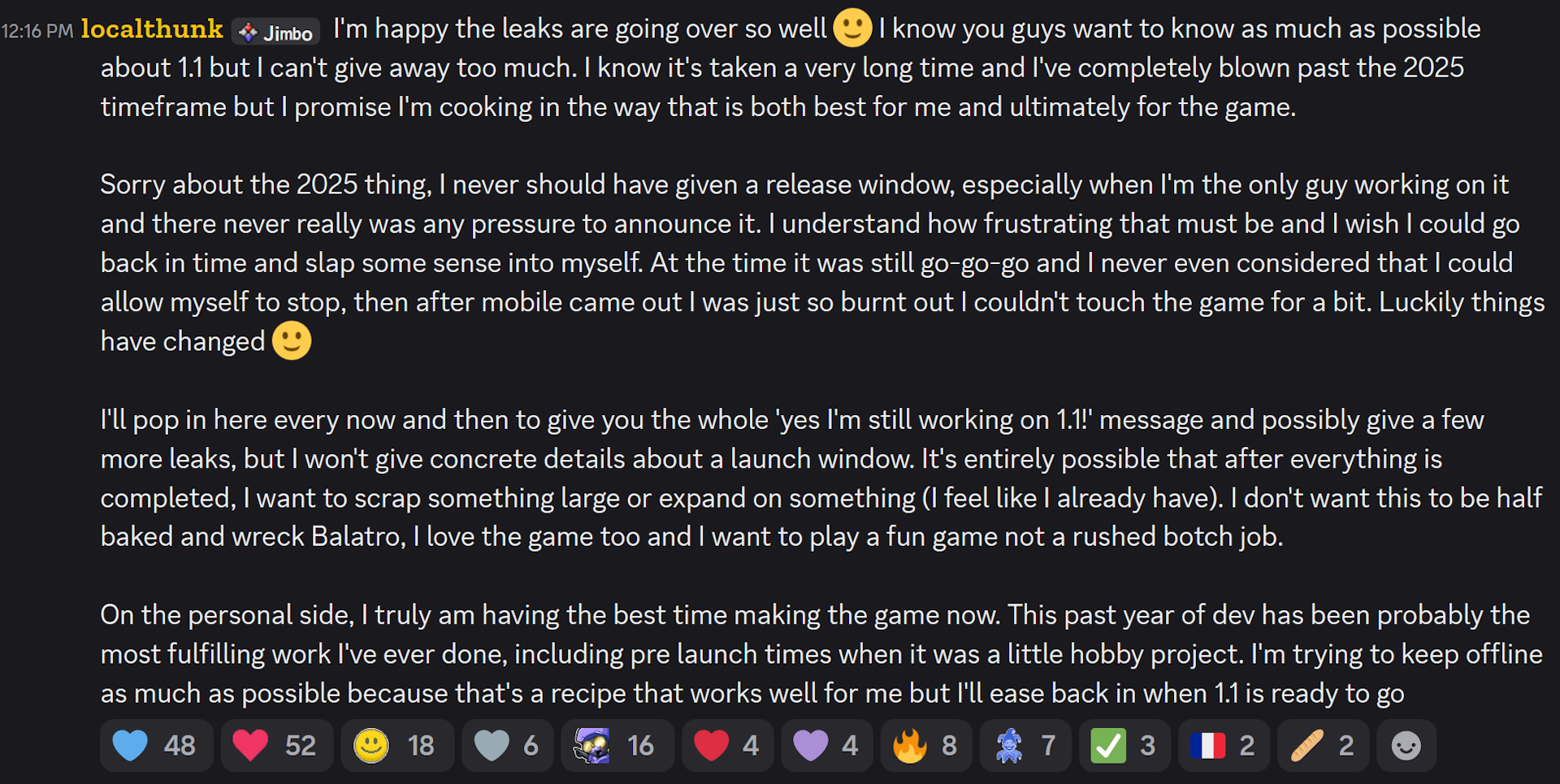
Consequently, LocalThunk said he'll continue to turn up in the Balatro Discord now and then to reassure people that the 1.1 update is still in development, and maybe post some more "leaks," but there won't be any commitment to a release target until it's ready to go. He also made clear that despite knowing people may be frustrated by the long wait, he's not going to speed things up: "I don't want this to be half baked and wreck Balatro, I love the game too and I want to play a fun game not a rushed botch job."
"I truly am having the best time making the game now. This past year of dev has been probably the most fulfilling work I've ever done, including pre launch times when it was a little hobby project," LocalThunk concluded. "I'm trying to keep offline as much as possible because that's a recipe that works well for me but I'll ease back in when 1.1 is ready to go."
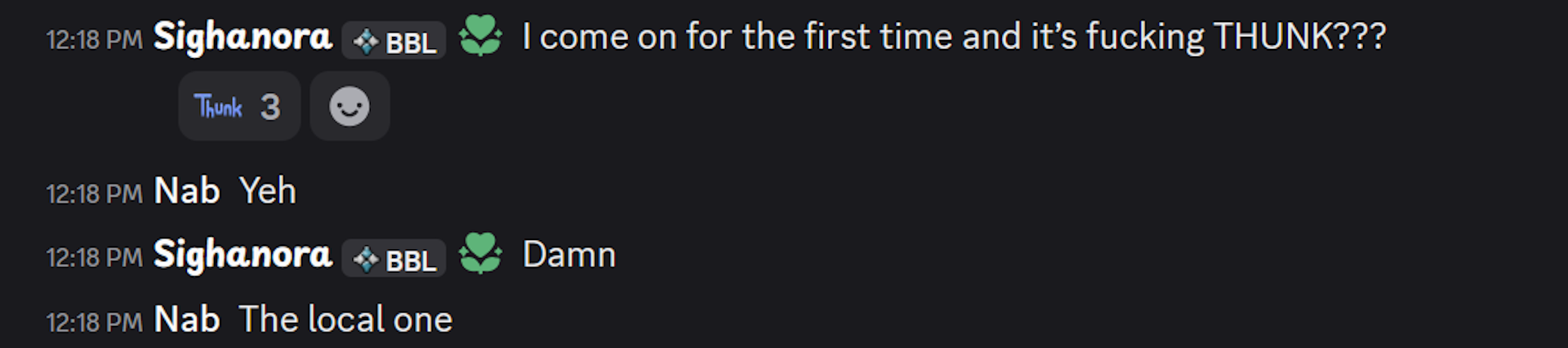
People on the Balatro Discord, for the record, showed no sign of the frustration or impatience LocalThunk is concerned about: Most of the responses expressed happiness that he's doing well and encouraged him to take his time with it. One apparent newcomer to the Discord was particularly excited by the mere appearance of the dev:
For Balatro heads eager for information on what the update will contain, LocalThunk shared more than just the 'four Jokers' tidbit above. The major points are collected in this Reddit thread: A tier 2 voucher named Lunker, algorithmic changes for picking the next voucher, a blue stakes rework, and that sort of thing. What really leapt out to me, though, is that LocalThunk expects the 1.1 update to be the end of the road: After the 1.1 update comes, a 1.1.1 update will follow "for balance tweaks and changes after player feedback."
"That's likely it," he wrote. "Don't expect any more than that." He also confirmed that Balatro will not be getting a multiplayer mode.
It should go without saying at this point, but I'll say it anyway: The Balatro 1.1 update sounds like it will be big, but there's absolutely no indication as to when it will arrive.

2026 games: All the upcoming games
Best PC games: Our all-time favorites
Free PC games: Freebie fest
Best FPS games: Finest gunplay
Best RPGs: Grand adventures
Best co-op games: Better together
"15 years ago, people understood it was an unfinished game": As Endless Legend 2 hits 1.0, Amplitude reflect on how early access has changed

Amplitude have always used early access for their games, even before Steam Early Access was a thing. Ahead of Endless Space's release in July 2012, players who preordered the game got immediate access to an alpha build that was steadily patched and updated on the lead up to launch.
To this day, the studio still uses its Games2Gether program, where they discuss design issues with players and poll them for thoughts on how to proceed. Right now, there are a small group of players giving feedback on the recently announced Humankind 2.
However, as Amplitude prepare to launch Endless Legend 2 after a year in early access, co-founder and CEO Romain de Waubert de Genlis readily admits "The whole thing has changed over time."